




Understanding Bump Steer on Classic Mustangs — And Why a Bump Steer Kit Matters
Every Mustang enthusiast knows that upgrading suspension components can dramatically improve handling and stability — but there’s one subtle steering issue that can undercut all that hard work if left unaddressed: bump steer.
A Simple Explanation of Bump Steer
Bump steer happens when the suspension moves up and down, but the steering linkage doesn’t move in the same way.
On a classic Mustang, the control arm and the tie rod each move in an arc as the suspension travels up and down. Ideally, those arcs should be very similar. When they are, the wheel goes straight up and down without changing direction.
When they aren’t similar, the tie rod effectively pushes or pulls the spindle as the suspension moves through the travel. That causes the wheel to toe in or toe out even though you didn’t turn the steering wheel. That unintended change in wheel direction is bump steer.
Why It Happens More After Modifications
From the factory, the steering geometry was designed around stock ride height and stock components. When you:
-
Lower the car
-
Change springs or control arms
-
Install different spindles or brakes
-
Run wider wheels and tires
…the angle of the tie rod changes. Now the tie rod and control arm are no longer traveling together in matching arcs. As the suspension compresses over a bump, the tie rod length effectively changes relative to the control arm — and the wheel steers itself.
What You Feel From the Driver’s Seat
When bump steer is present, the car may:
-
Dart left or right over bumps
-
Feel unstable on uneven pavement
-
Require constant small steering corrections
-
Feel fine on smooth roads but nervous on rough ones
This is why bump steer is often mistaken for an alignment issue when it’s actually a geometry issue.
How a Bump Steer Kit Fixes It
A bump steer kit (like adjustable tie rod ends) lets you raise or lower the tie-rod connection point at the spindle. This adjustment brings the tie rod back into a better relationship with the control arm, so both parts can move through a more similar arc.
When the arcs match:
-
The suspension can move through its intended vertical travel
-
The wheel stays pointed straight
-
The car feels stable and predictable
A bump steer kit lets you fine-tune your steering linkage’s geometry at the tie rod connection point so that it’s more closely matched to the suspension’s motion path. The core idea is to bring the tie-rod connection point back into the correct relationship with the control arm arcs so that when the wheels move up and down, they maintain consistent toe — not an unwanted steering input.
The Big Takeaway
Bump steer isn’t about steering input — it’s about suspension movement causing steering input.
Correcting it doesn’t just improve handling — it restores confidence when driving, especially on lowered or modified classic Mustangs.
That’s where the Baer Tracker Adjustable Tie Rod Ends come in.
Featured Solution: Baer Tracker Adjustable Tie Rod Ends
65-66 Mustang & 64-65 Falcon – V8 Spindles, Manual Steering
Product: 65-66 Mustang, 64-65 Falcon Baer Tracker Adjustable Tie Rod Ends from Stang-aholics.com
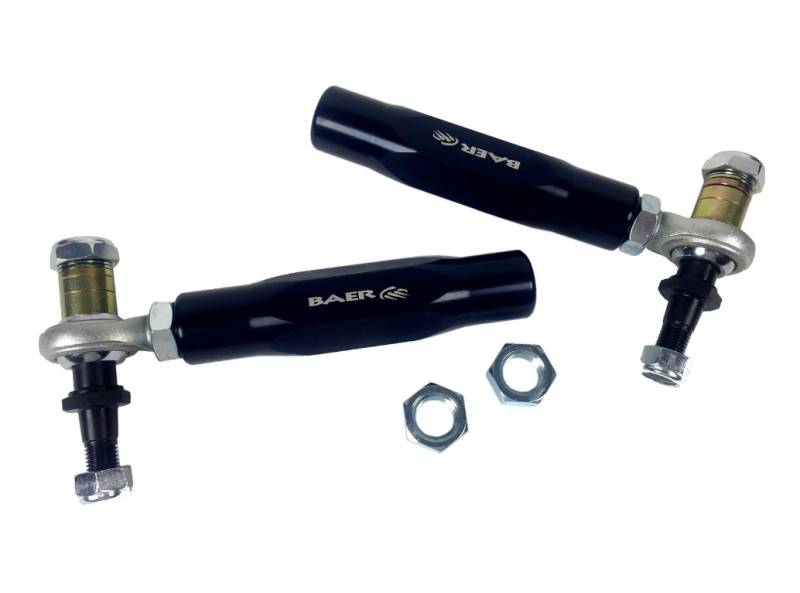
These tie rod ends are designed to address bump steer in classic Mustangs with stock V8 spindles and manual steering by offering adjustability at the spindle — allowing you to dial in proper steering geometry. The design includes:
-
Fully adjustable tie rods to correct bump steer caused by lowered suspensions or geometry changes
-
A robust Teflon-lined Heim joint for precise motion and reduced deflection
-
6061-T6 aluminum sleeve with corrosion-resistant black anodizing
-
No spindle modifications required thanks to the correct taper on the included pins
With roughly 0.875″ of adjustment, these tie rod ends let you fine-tune the steering link’s position relative to the control arms — the key requirement for reducing unwanted toe changes during suspension travel.
When You Really Need a Bump Steer Kit
Not every Mustang will exhibit dramatic bump steer, but you’ll see the biggest improvements when:
✔ You’ve lowered your Mustang from stock ride height
✔ You’ve upgraded suspension components (springs, shocks, control arms)
✔ You’re running larger, wider tires
✔ You’re chasing better handling in street, autocross, or track use
If your parked Mustang rides flat and points straight in the garage but wanders or kicks over bumps on the road — that’s a telltale sign bump steer is influencing the ride. A quality bump steer setup like the Baer Tracker adjustable tie rod ends, can give you control back in the driver’s seat.
Wrap-Up: Why Bump Steer Matters for Classic Mustang Owners
Even though bump steer isn’t immediately obvious in everyday driving, it matters — especially as we mentioned, for modified or lowered cars. By optimizing the steering geometry with an adjustable bump steer kit, you’ll enjoy:
-
More predictable handling
-
Improved stability at speed
-
Better response over rough roads
-
Reduced tire wear and alignment headaches
Whether you’re building a daily driver or a street/strip classic, addressing bump steer with high-quality components is a smart move that pays dividends in confidence, safety, and performance.
Ready to dial in your Mustang’s steering geometry? Check out the Baer Tracker Adjustable Tie Rod Ends on our Website here:
65-66 Mustang and Falcon Baer Tracker Adjustable Tie Rod Ends, Stock Spindles
67-69 Mustang Baer Tracker Adjustable Tie Rod Ends, Stock Spindles
70-73 Mustang Baer Tracker Adjustable Tie Rod Ends, Stock Spindles

You must login to post comments.